









Is It Necessary to Disinfect Your Ice Cream Display Freezer?
This is a frequently overlooked question: can a seemingly spotless unit—whether it’s an Ice Cream Freezer —truly be hygienic? typically operate between -18℃ and -25℃. While this temperature range can inhibit bacterial growth, thorough disinfection is still mandatory before first use, or once every six months for ongoing operation.
Low Temperature Does Not Equal Sterility
Many people hold a common misconception: bacteria cannot survive in freezing temperatures, so frequent disinfection is unnecessary. This idea could not be further from the truth. Most bacteria simply enter a dormant state under frozen conditions, and will become active again once the temperature rises back to a suitable range. Even more alarming, there are psychrotrophic bacteria—such as Listeria and Yersinia—that can grow slowly even in environments below 0℃.
Listeria, in particular, is a common hidden risk in frozen foods. It has an extremely high tolerance to low temperatures, and can even survive in environments as cold as -20℃. If pregnant women, the elderly, or people with compromised immune systems consume ice cream contaminated with Listeria, it can lead to severe health complications.
Furthermore, the interior of the freezer is not completely sealed. Every time the door is opened and closed, outside air, dust, and microorganisms can enter the unit. Other potential sources of contamination include packaging surfaces touched by customers’ fingers during selection, contaminants brought in by staff when restocking, and even the condensed water that accumulates on the door seal.
How Severe Are the Risks of Skipping Cleaning and Disinfection?
Imagine an ice cream freezer for ice cream shop that has run continuously for three months without ever receiving a full disinfection—what could happen?
First, visible contamination directly hurts sales. A thin mist, a mixture of grease and dust, will gradually form on the glass door. Mold spots may appear in the internal corners, and black or green mold can grow on the door seal. No matter how delicious the ice cream inside is, customers’ willingness to purchase will drop significantly.
Second, cross-contamination and flavor transfer between different products. While most frozen items have individual packaging, the internal air circulation can carry microorganisms and odor molecules. Without regular disinfection, the packaging of strawberry ice cream may absorb the smell of matcha flavor. Even worse, if a package has a tiny tear and its contents leak, it can contaminate the surrounding products.
Third, the risk of equipment malfunctions increases. Without regular cleaning, dust and dirt will accumulate on the evaporator fins, reducing cooling efficiency and causing the compressor to run for extended periods. This not only drives up power consumption, but also shortens the service life of the equipment, a cost that can add up significantly over time.
Fourth, and most critically—food safety hazards. The Listeria we mentioned earlier thrives in the humid, low-temperature environment of ice cream display freezers. The U.S. Centers for Disease Control and Prevention (CDC) has issued multiple alerts for Listeria infections linked to such equipment, and investigations have found that some cases were connected to contaminated display freezers during production or sales. This risk is very real.
What Is the Correct Disinfection Method?
Disinfection is not complicated; the key is to do it regularly, properly, and thoroughly. Below are professional recommendations:
Disinfection Frequency:
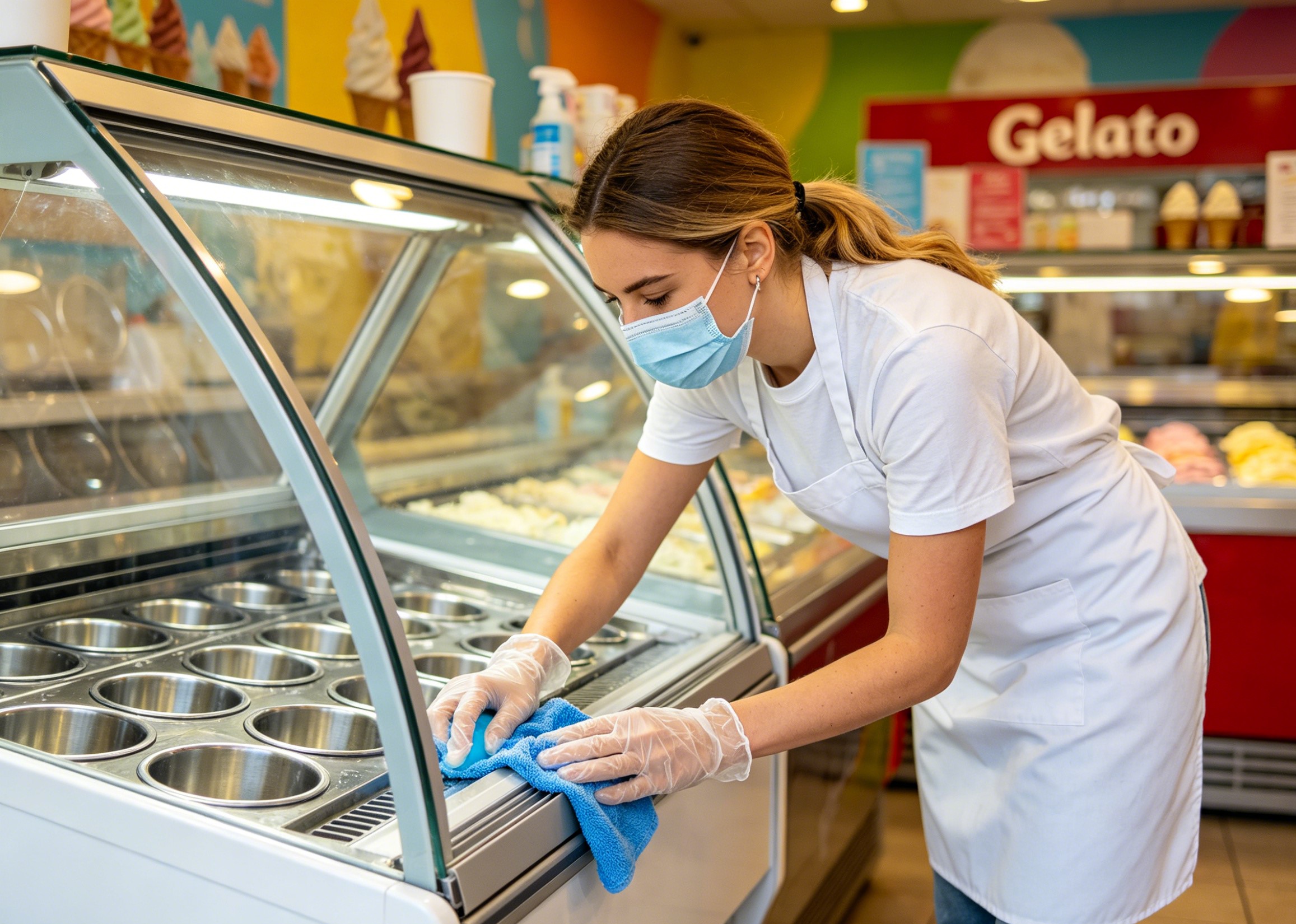
- Daily cleaning: After business hours each day, wipe the glass door, handles, and the external surface of the unit with a clean damp cloth.
- Deep disinfection: We recommend conducting a full disinfection at least once a week, covering all internal surfaces, shelves, door seals, and other components.
- Special cases: If an ice cream package tears and its contents leak, perform immediate local cleaning and disinfection right away.
Standard Disinfection Process (5-Step Method):
Step 1: Empty and Power Off
Remove all products from the display freezer and place them in a backup refrigeration unit or insulated cooler. Unplug the power, and let the unit warm up naturally to near room temperature (this avoids thermal shock that can crack the cold glass if you pour hot water directly on it).
Step 2: Initial Cleaning
Dip a soft cloth in warm water, and wipe the inner walls, shelves, bottom, and inner surface of the glass to remove visible stains, frost, and residue. Do not use hard tools like steel wool, as they can scratch the stainless steel or glass surfaces.
Step 3: Disinfection Treatment
Choose a food-grade disinfectant, such as a chlorine-based disinfectant with an available chlorine concentration of 100-200mg/L, or 75% medical alcohol. Spray or wipe the disinfectant evenly across all internal surfaces, paying special attention to hard-to-reach areas like the crevices of the door seal, the drain hole, and corners. Let the disinfectant sit for 10-15 minutes to take effect.
Step 4: Thorough Rinsing
Use a clean damp cloth dipped in drinking water (preferably boiled and cooled water or purified water) to wipe all surfaces that came into contact with the disinfectant multiple times, to remove any residue. This step is critical: residual disinfectant can corrode the equipment, or transfer onto the ice cream packaging.
Step 5: Drying and Restoration
Dry all surfaces with a dry cloth, and leave the door open to ventilate naturally for 20-30 minutes to ensure the interior is completely dry. Plug the power back in, and once the temperature drops to the set level, put the ice cream products back in place.
Notes:
- Do not use disinfectants with strong irritating odors (such as undiluted 84 disinfectant), as the smell can be absorbed by the ice cream and affect its flavor.
- Do not rinse the cold glass door directly with hot water, as this can cause it to crack.
- Wear gloves and a mask during disinfection to protect your own safety.
- Record the time and operator of each disinfection for traceability.
Tailored Recommendations for Different Scenarios
Small dessert shops / bubble tea shops: These locations have high usage frequency and frequent door opening and closing, so we recommend shortening the disinfection cycle to once every 3-5 days.
Convenience stores / supermarkets: With high foot traffic and display freezers that run year-round, it is best to schedule disinfection during off-peak hours at night. Due to frequent restocking, pay special attention to the first-in, first-out rule for different batches of products, to avoid expired packages lingering for too long and causing contamination.
Small ice cream freezers for home use: Even though they have lower usage frequency, they still need to be disinfected once a month. Hygiene is easier to overlook in home environments; in fact, various foods stored in the refrigerator can cross-contaminate the ice cream freezer through hand contact.
Frequently Asked Questions
Q: Can I use dish soap instead of a special disinfectant?
A: Dish soap only removes dirt, and has limited bactericidal effect, so it cannot replace disinfectant. We recommend using food-grade chlorine-based disinfectant or alcohol.
Q: Can I use an ozone disinfector?
A: Yes, but you need to pay attention to the ozone concentration and usage time. After disinfection, you must ventilate thoroughly, as residual ozone can have adverse effects on humans and some foods. In commercial scenarios, ozone disinfection is usually used as an auxiliary measure.
Q: Do I need to remove the frost in the display freezer first?
A: Yes. The frost layer will prevent the disinfectant from making contact with the surfaces. You should first power off the unit to defrost, or use a special defrosting shovel (be careful not to puncture the refrigeration pipes).
Q: What should I do if the door seal gets moldy?
A: The door seal is a common hard-to-reach hygiene area. If it is just surface mold spots, wipe them carefully with a cotton swab dipped in alcohol. If the mold has penetrated deep into the rubber, we recommend replacing the seal with a new one. It is low-cost and delivers immediate results.
Going back to our original question: do you need to disinfect your ice cream display freezer? The answer is clear and resounding—yes. This is not a redundant process that adds to your workload; it is a fundamental step to take responsibility for your customers’ health, your shop’s reputation, and the results of your own business operations.


Most popular More «
-
Selection Guide for Shelving Systems of Refrigerated Beverage Display Cabinets
-
How to Control the Procurement Cost of Open Refrigerated Display Cabinets for Supermarkets
-
Air vs Direct Cool Cake Cabinets Advantage and Disadvantage
-
How to Choose an Open Display Cooler for Your Fruit Store?
-
What Is the Standard Temperature for Dessert Display Cabinets?
-
Top Compact Upright Display Cooler for Retail Businesses
-
SM15A Commercial Slush Machine Specification
-
Commercial Pastry Display Case Buying Guide for Bakeries & Cafés
-
Cooluma Ice Machines for Seafood Sections in Supermarkets
-
Cooluma Turnkey Coffee Shop Solution