









Why is refrigerator foaming technology a "must-have" in the refrigeration industry?
When you open the fridge for a cold drink in summer, have you ever wondered: how does the cold air stay “locked” inside once the door closes? Those seemingly insignificant “foam” layers between the outer shell and inner liner are actually the core secret to the refrigerator's stable cooling—all thanks to foam technology.
Some might wonder: With so many insulation methods available—like vacuum insulation or glass wool—why did refrigerators specifically choose foam technology? Today, we'll explore this question from three core angles: practicality, cost-effectiveness, and adaptability. By the end, you'll understand the rigorous industrial logic behind this choice.
I. Core Requirement: Ultimate Insulation as a Prerequisite, Precisely Matched by Foam Technology
At its core, a refrigerator functions as a “heat transporter”: the compressor moves internal heat to the exterior, maintaining low temperatures inside. However, if insulation is poor, external heat continuously seeps in, forcing the compressor to run nonstop—wasting energy and accelerating wear. Thus, “preventing heat exchange” is the primary mission of a refrigerator's insulation layer.
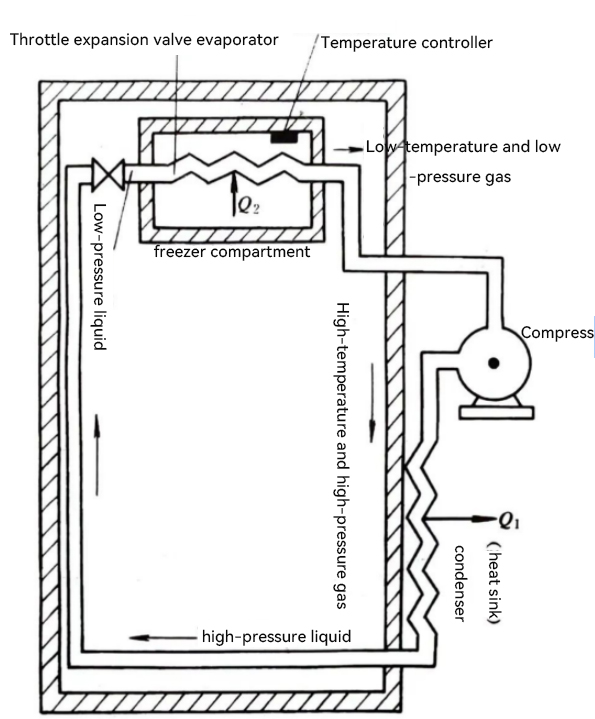
The core material in foam technology is “rigid polyurethane foam.” During foaming and molding, this material forms countless sealed micro-bubbles (with a closed-cell rate exceeding 90%). The air trapped within these bubbles is firmly locked in. Air itself is an excellent thermal insulator, significantly reducing heat transfer efficiency. Simply put: the “tiny air bubbles” within the foam act like miniature “insulation chambers,” completely blocking the passage of heat between the interior and exterior.
Compare this to other insulation methods: Vacuum insulation offers superior performance but comes with extremely high costs. Moreover, the vacuum layer is prone to “vacuum loss” due to transportation vibrations or aging during use. Once compromised, its insulation effectiveness drops to zero. Insulation materials like glass wool and rock wool, while inexpensive, are highly absorbent. Their insulation performance significantly deteriorates when damp, and they may foster mold growth—making them fundamentally unsuitable for humid environments like refrigerators.
Polyurethane rigid foam, however, not only excels in thermal insulation (with a thermal conductivity of just 0.022-0.026 W/(m·K), far below air's 0.028 W/(m·K)), but also achieves “zero water absorption and zero air permeability,” making it perfectly suited for refrigerator applications.
II. Structural Advantages: “One-piece molding” saves space and enhances stability
While the refrigerator's exterior shape is fixed, the space between its inner liner and outer shell is irregular—featuring corners, grooves, and gaps where pipes pass through. Filling this space with traditional insulation materials (like cut foam boards) often leaves gaps, which become “leaks” allowing heat to escape.
A core advantage of foam technology is “on-site foaming and one-piece molding”: Workers inject liquid polyurethane material into the cavity between the refrigerator's outer shell and inner liner. The material undergoes a rapid chemical reaction, expanding dozens of times in volume to fill all irregular gaps. Upon cooling, it forms a seamless, integrated insulation layer.
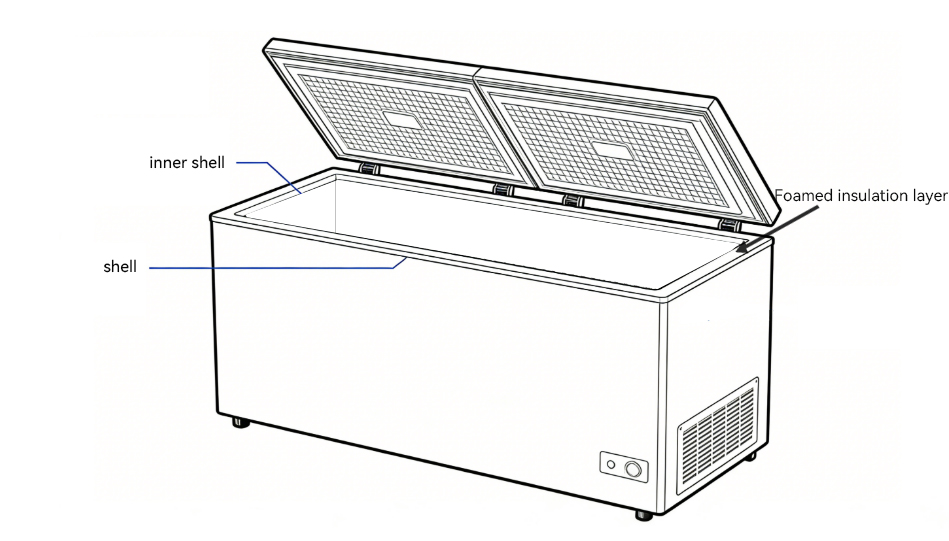
This “seamless filling” not only eliminates potential heat leakage but also tightly bonds the insulation layer to the refrigerator's outer shell and inner liner, effectively adding a “skeleton” to the appliance. Many may not realize: older refrigerators often experience liner loosening during transport, whereas models using integral foaming technology exhibit significantly enhanced structural stability and resistance to deformation.
More importantly, the thickness of the foam layer can be precisely controlled. Since the freezer and refrigerator compartments have different insulation requirements (the freezer requires a thicker layer due to lower temperatures), adjusting the amount of foam material injected enables “differentiated insulation.” This ensures optimal cooling performance without wasting space—a key reason modern refrigerators achieve “slim profiles with large capacities.”
III. Cost and Process: The Optimal Solution for Industrial Production
For large appliances like refrigerators, “value for money” is the core competitive advantage, and foaming technology perfectly balances ‘performance’ and “cost.”
From a raw material cost perspective, polyurethane rigid foam ingredients are relatively inexpensive, and the foaming process achieves extremely high material utilization (virtually no waste, as injected material expands to completely fill cavities). In terms of production efficiency, the foaming molding process is very short (typically completed in minutes), making it highly suitable for assembly line production. Today, the foaming process for a refrigerator can be completed in just tens of seconds using automated equipment, significantly reducing the production cycle.
In contrast, vacuum insulation technology presents significant challenges: the production equipment for a single vacuum insulation layer costs several to over ten times that of foaming equipment. Additionally, its lengthy production cycle struggles to meet the demands of large-scale manufacturing. This explains why vacuum insulation is reserved for a limited number of high-end refrigerators (such as certain imported built-in models), while foam insulation dominates the mainstream household refrigerator market.
Furthermore, foam insulation offers exceptional compatibility. Whether it's a direct-cool or air-cool refrigerator, or a single-door, double-door, or French-door model, foam insulation layers can be adapted to fit. The foam layer also provides some sound insulation—vibrations generated by the compressor are partially absorbed by the foam layer, making the refrigerator quieter during operation.
IV. Common Questions: Does the Foam Layer Age? Is It Safe?
Many may worry: After prolonged use, will the foam layer age or shrink, reducing insulation effectiveness? In reality, there's no need for excessive concern.
A qualified polyurethane rigid foam insulation layer ages extremely slowly. Under normal usage conditions (avoiding high temperatures and open flames), the foam layer can last over 10 years, matching the refrigerator's overall lifespan. Moreover, many refrigerator manufacturers now add anti-aging agents and flame retardants to the foam raw materials, further enhancing the foam layer's stability and safety.
Regarding safety: Polyurethane rigid foam is inherently non-toxic. Once foamed and cured, it forms a stable solid that does not release harmful substances. China enforces strict environmental standards for refrigerator foam materials. Reputable brands comply with GB/T 8059-2016 “Refrigerating Appliances for Household and Similar Use,” ensuring safe usage.
In summary, the choice of foam technology for refrigerators isn't a matter of “no alternatives,” but rather the optimal solution—it meets core requirements for ultimate insulation and structural integrity while aligning with industrial production's cost and efficiency demands, and accommodating diverse refrigerator designs.
Without foam insulation technology, today's highly cost-effective, large-capacity, low-energy-consumption household refrigerators simply wouldn't exist. Next time you open your fridge, take a moment to notice its outer shell—those unseen foam layers are quietly safeguarding the freshness of your food.

Most popular More «
-
Air vs Direct Cool Cake Cabinets Advantage and Disadvantage
-
How to Choose an Open Display Cooler for Your Fruit Store?
-
What Is the Standard Temperature for Dessert Display Cabinets?
-
Top Compact Upright Display Cooler for Retail Businesses
-
SM15A Commercial Slush Machine Specification
-
Commercial Pastry Display Case Buying Guide for Bakeries & Cafés
-
Cooluma Ice Machines for Seafood Sections in Supermarkets
-
Cooluma Turnkey Coffee Shop Solution
-
How To Choose Commercial Display Freezer For Ice Cream Shop
-
Solutions to Glass Fogging & Water Dripping for Café Cake Display Fridges