









Why do cake display cabinets all use R290 refrigerant?
You might not have noticed while browsing a bakery, but behind those display cases showcasing cream cakes, mousse desserts, and other pastries lies a critical choice concerning environmental protection, energy efficiency, and food safety—the refrigerant. Today, an increasing number of commercial cake display cases are adopting R290 refrigerant, replacing once-dominant types like R22 and R134a. According to multiple global brand suppliers by 2025, R290 usage will become the norm.
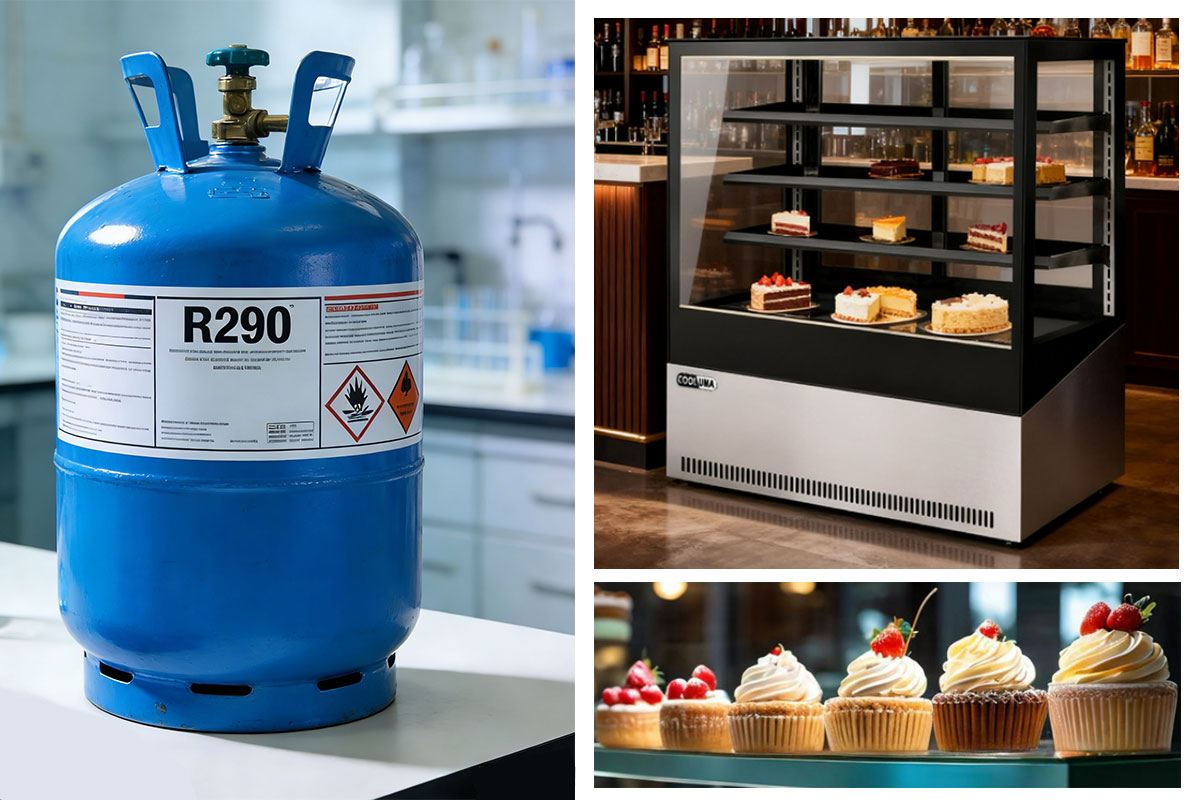
Some might ask: Isn't it just a refrigerant “fluid”? Does changing the model really matter that much? For bakery countertop cake display cabinets, Cooluma emphasizes that choosing the right refrigerant directly impacts dessert freshness, business operating costs, and even our ecological environment.
I. Environmental Imperative: Zero Ozone Depletion + Minimal Global Warming Potential, Aligning with Global Emissions Reduction Trends
Environmental attributes have long been a mandatory criterion in refrigerant selection. Traditional refrigerants like R22 deplete the ozone layer, while R134a, though ozone-friendly, carries a global warming potential (GWP) exceeding 1300—making it a potent greenhouse gas. With the advancement of international conventions like the Montreal Protocol and the Paris Agreement, refrigerants with low GWP and zero ODP (Ozone Depletion Potential) have become the industry's inevitable choice.
R290 refrigerant (commonly known as propane) precisely meets the core environmental requirements. Its ODP value is 0, meaning it causes no damage to the ozone layer; Its GWP is only 3, far below R134a's 1300 and even an order of magnitude lower than some so-called “environmentally friendly alternative refrigerants.” For bakeries, choosing R290 cake display cabinets not only complies with national environmental policies but also demonstrates corporate social responsibility.
More crucially, policies are intensifying efforts to promote eco-friendly refrigerants. The 2024 “Guidance on Accelerating Green Transformation of Cold Chain Logistics Infrastructure” jointly issued by the National Development and Reform Commission and the Ministry of Industry and Information Technology explicitly states that by 2025, products meeting Tier 1 energy efficiency standards must account for over 60% of terminal equipment like commercial display cabinets. R290 stands as one of the core technological enablers for achieving this target. Local governments have also introduced targeted subsidies, offering up to 800 yuan per unit for purchasing high-efficiency cake display cabinets compliant with the new national standards. This further accelerates the market penetration of R290 cake display cabinets.
II. Rapid Cooling and High Energy Efficiency: Precisely Meeting Cake Preservation Needs
Cake preservation demands extremely precise temperature control, typically requiring a stable environment between 2-8°C. This necessitates reliable cooling performance without significant temperature fluctuations, as such variations can compromise cream texture and cake shelf life. R290's thermodynamic properties perfectly align with these refrigeration requirements.
First, R290's latent heat of vaporization is approximately 1.8 times that of R22. This means each unit mass of R290 removes more heat, resulting in higher refrigeration efficiency. Experimental data shows that under identical operating conditions, refrigeration equipment using R290 reduces cycle time by approximately 18.8% and increases 24-hour refrigeration capacity by nearly 38%. Even for multi-tier cake display cases, it rapidly achieves the set temperature. Furthermore, it quickly restores low temperatures after frequent door openings, effectively preventing cake spoilage caused by temperature fluctuations.
Second, R290 offers significant energy savings. Its viscosity is only 60% that of R22, reducing flow resistance in pipes and heat exchangers. Its higher thermal conductivity also enhances heat exchange performance. When paired with specialized refrigeration lubricants, R290-equipped cake display cases achieve 15%-30% electricity savings. For bakeries requiring prolonged daily operation, this represents substantial savings—a standard cake display cabinet consumes approximately 10 kWh daily. Switching to R290 yields daily savings of 1.5–3 kWh, translating to significant annual electricity cost reductions.
Additionally, R290 requires significantly lower charge volumes than traditional refrigerants. With a liquid density of only 42%-45% that of R22, its adoption substantially reduces refrigerant charge during replacement. This not only lowers initial refrigerant procurement costs but also minimizes the risk and financial impact of future leaks.
III. Cost Advantage: Abundant Raw Materials, Stable Pricing, More Cost-Effective for Long-Term Use
For commercial users, equipment operating costs are a critical consideration, and R290 offers clear advantages here. Derived from purified petroleum liquefied gas, R290 benefits from abundant and low-cost raw materials. In contrast, the price of traditional refrigerant R134a has surged significantly in recent years. As of May 2025, its price per ton has risen from approximately ¥30,000 at the beginning of 2024 to nearly ¥50,000, while R290's price has remained stable and substantially lower than R134a.
Beyond the inherent cost advantage of the refrigerant itself, R290 cake display cabinets also feature lower long-term maintenance costs. R290's stable chemical properties, coupled with premium-grade products boasting 99.96% purity, reduce system corrosion and blockages, extending the lifespan of core components like compressors. Simultaneously, as R290 refrigerant becomes more widespread, related repair techniques and spare parts are maturing. Technicians can more easily find compatible components and maintenance solutions, further reducing upkeep expenses.
R290 is propane—isn't it flammable and unsafe?
Many people see R290 as propane and immediately think “flammable, unsafe.” This concern is actually unnecessary, as R290 cake display cabinets produced by reputable manufacturers have long addressed flammability issues through technical design.
On one hand, the refrigerant charge in R290 cake display cabinets is strictly controlled within safe limits. International standards clearly restrict the permissible charge per unit for R290. As small commercial refrigeration equipment, cake display cabinets require minimal refrigerant charge, far below the lower flammability limit.
On the other hand, manufacturers incorporate explosion-proof electrical components—such as explosion-proof compressors and fans—to prevent electrical sparks from creating hazards. Additionally, leak detection agents are added to the system. While standard R290 is colorless and odorless, the incorporation of garlic-scented agents enables rapid detection of leaks, allowing for prompt remediation.
Safety Concerns
Years of practical application have thoroughly validated R290's safety in small, sealed refrigeration systems. Major refrigeration equipment manufacturers have accumulated mature expertise in fire and explosion prevention design. As long as products are purchased through legitimate channels and meet quality standards, there is absolutely no need to worry about safety during use.
From an environmental perspective, R290 has zero ozone depletion potential and minimal greenhouse effect, aligning with global emission reduction trends and national policy directions; Performance-wise, its rapid cooling, high energy efficiency, and precise temperature control perfectly meet the core requirements for cake preservation. Cost-wise, abundant supply, stable pricing, and low maintenance expenses help businesses save money. Combined with mature safety technology, R290 naturally becomes the preferred refrigerant for cake display cabinets.
For consumers, the R290 eco-friendly refrigerant is a common choice that indirectly contributes to environmental protection while reducing operational costs.
Most popular More «
-
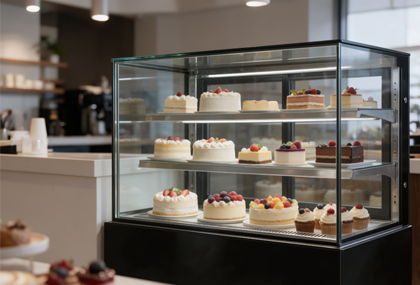
Air vs Direct Cool Cake Cabinets Advantage and Disadvantage
-
How to Choose an Open Display Cooler for Your Fruit Store?
-
What Is the Standard Temperature for Dessert Display Cabinets?
-
Top Compact Upright Display Cooler for Retail Businesses
-
SM15A Commercial Slush Machine Specification
-
Commercial Pastry Display Case Buying Guide for Bakeries & Cafés
-
Cooluma Ice Machines for Seafood Sections in Supermarkets
-
Cooluma Turnkey Coffee Shop Solution
-
How To Choose Commercial Display Freezer For Ice Cream Shop
-
Solutions to Glass Fogging & Water Dripping for Café Cake Display Fridges