









Cooluma Ice Cream Freezer Materials
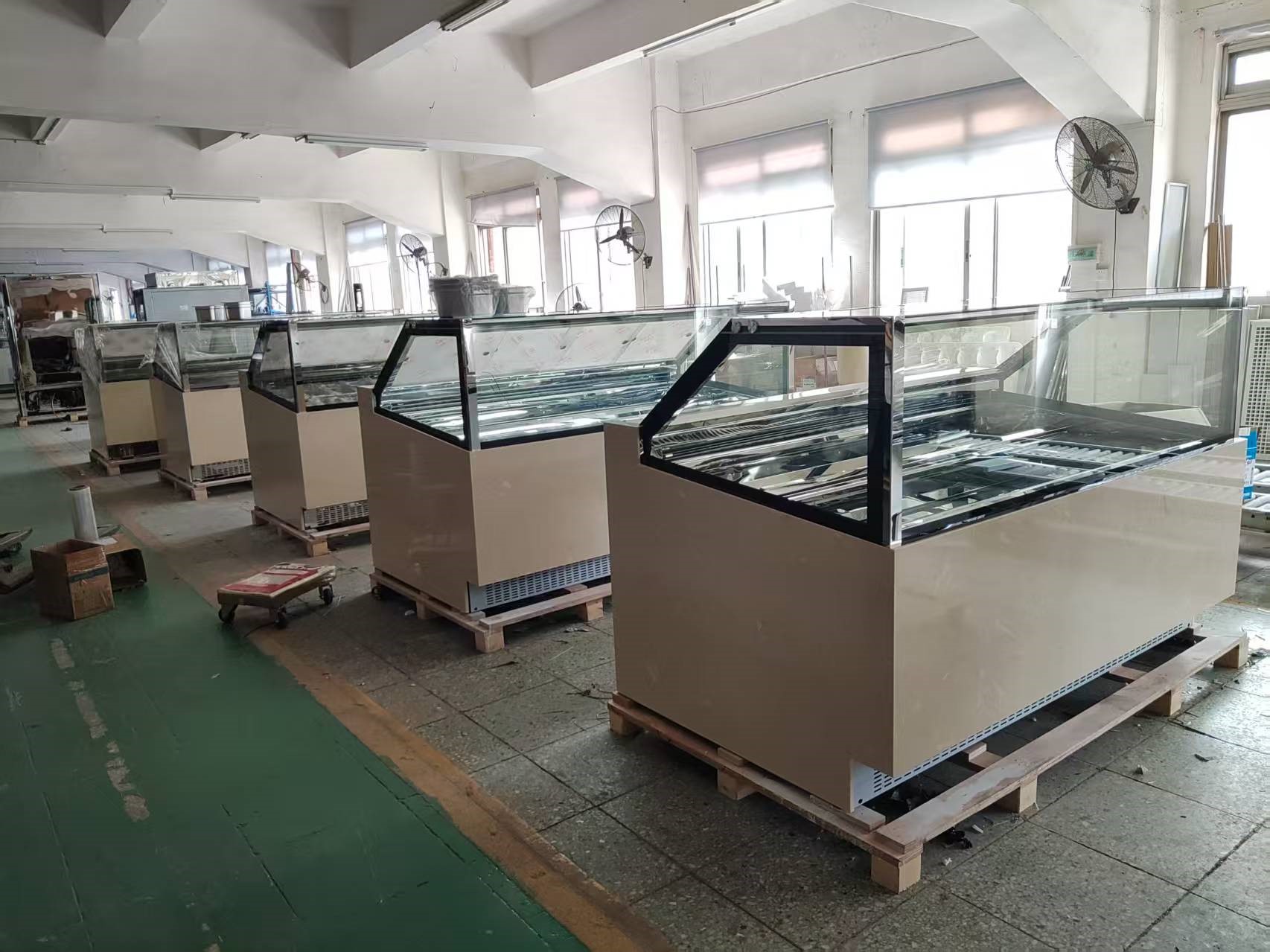
Cooluma offers a range of commercial ice cream equipment that meets standards for hygiene and safety, service life, and refrigeration efficiency. For mainstream commercial ice cream machines on the market, the body materials are structured as food-grade stainless steel as the core, food-grade plastics as the supplement, and ordinary steel/color-coated steel as the low-end alternative. These different materials vary significantly in terms of safety standards, durability, cost, and other key dimensions.
I. Classification and Core Characteristics of Mainstream Body Materials
The body of a commercial ice cream machine can be divided into two categories: food contact components (inner tank, material cylinder, discharge port, mixing shaft) and non-food contact components (outer shell, frame, base, control panel). These two types of components have different material requirements, and the core mainstream materials are as follows:
(1) Food-Grade Stainless Steel: The Absolute Industry Mainstream, Standard for High-End Models
Stainless steel is the preferred material for the entire body of commercial ice cream machines (including both contact and non-contact components). Among them, 304 stainless steel is the basic industry standard, while 316L stainless steel is the high-end upgraded version. Its core characteristics revolve around the four key pillars of "safety, corrosion resistance, easy cleaning, and durability".
304 Stainless Steel (06Cr19Ni10): The King of Cost-Effectiveness, Commercial Standard
Composition and Safety: With a chromium content of ≥18% and nickel content of ≥8%, it complies with the GB 4806.7-2016 food contact safety standard, passing heavy metal migration tests (Pb≤0.01mg/kg, Cr≤0.05mg/kg). It poses no risk of heavy metal leaching and can directly contact high-sugar, high-fat ingredients such as ice cream mix and dairy products.
Corrosion and Weather Resistance: Its dense, non-porous surface resists corrosion from lactic acid in dairy products, acid-base cleaning agents, and humid environments. In coastal high-salt fog and southern high-humidity environments, it can be used continuously for 3-5 years without structural rust spots, far outperforming ordinary steel.
Easy Cleaning and Hygiene: Processed with mirror polishing or wire drawing, it has a surface roughness Ra≤0.8μm, with no hygiene dead corners, making it difficult for milk slurry to residue or bacteria to breed. It supports high-temperature disinfection and high-pressure water gun cleaning, adapting to the high-frequency cleaning needs of the catering industry.
Structure and Durability: Using integrated stretch forming technology (for inner tanks/material cylinders), it has no welding gaps, enabling high cold energy transfer efficiency and faster refrigeration. The whole machine has high strength, impact resistance, and vibration resistance, adapting to commercial scenarios with continuous dispensing and frequent start-stop operations, with a service life of up to 5-8 years.
Applicable Scenarios: More than 90% of mid-range commercial models (such as brands like Donper, Haichuan, Guangshen) cover mainstream scenarios such as milk tea shops, dessert shops, convenience stores, and small supermarkets.
316L Stainless Steel (022Cr17Ni12Mo2): High-End Upgrade, Preferred for Special Scenarios
Core Upgrade: With the addition of molybdenum (Mo) element, its chloride ion corrosion resistance is greatly improved. It is more resistant to salt fog, acid and alkali than 304 stainless steel, making it suitable for seaside stores, high-salt dairy product formulas, and scenarios where chlorine-containing disinfectants are frequently used.
Other Features: It inherits all the advantages of 304 stainless steel, with stronger high and low temperature resistance, able to withstand temperature fluctuations from -30℃ to 150℃. The inner tank will not deform or crack even after long-term low-temperature operation.
Applicable Scenarios: High-end dessert studios, chain catering brands, coastal scenic spot stores, and export models (complying with EU FDA, ISO 22000 standards).
(2) Food-Grade Plastics: Dedicated to Auxiliary Components, Lightweight and Low-Cost
Food-grade plastics are mainly used for non-load-bearing, non-high-temperature, indirect food contact components, such as outer shell decorative panels, material cylinder lids, discharge port handles, control panel shells, and material receiving trays. The mainstream materials are polycarbonate (PC), ABS, food-grade PP.
Core Advantages: Lightweight (30%-50% lighter than stainless steel), low cost (1/3-1/2 the price of stainless steel), easy to form (can be made into colorful, curved, special-shaped designs for a more fashionable appearance), and good insulation (reducing the risk of electric leakage and improving electrical safety).
Key Limitations: Poor high-temperature resistance (long-term use temperature ≤80℃, cannot be close to high-temperature components such as compressors), easy to age (prone to yellowing, brittleness, and cracking after 1-2 years of ultraviolet radiation and frequent cleaning), and weak corrosion resistance (prone to residual odor and bacteria growth after long-term contact with dairy products).
Applicable Scenarios: Low-end commercial models, household-commercial dual-purpose machines, and street vending equipment with limited budget; they are only used for non-direct food contact components and are strictly prohibited for core contact parts such as inner tanks and material cylinders.
(3) Ordinary Steel/Color-Coated Steel: Dedicated to Low-End Models, First Choice for Short-Term Transition
Ordinary steel (cold-rolled steel plate) and color-coated steel (painted steel plate) are only used for the outer shells and frames of ultra-low-end commercial machines, second-hand refurbished machines, temporary street vending equipment. They are phased-out materials in the market, with core characteristics of "low cost, low durability, high risk".
Core Defects: No rust resistance, it will rust within 3-6 months in a humid environment, and the falling rust can easily contaminate food; no food-grade certification, high risk of heavy metal leaching, which is harmful to health after long-term contact with dairy products; low strength, poor impact resistance, easy to deform under vibration, with a service life of only 1-2 years.
Only Advantage: Extremely low price (the whole machine cost is 40%-60% lower than stainless steel models), suitable for short-term transition scenarios within 1 year such as temporary street vending and temporary events.
Industry Warning: It does not comply with the GB 4806.7 food contact standard. Regular catering stores and chain brands are strictly prohibited from using it, and it is a key inspection target for market supervision.
(4) Other Auxiliary Materials: Dedicated to Sealing and Connection
In addition to the main materials, the seals, pipelines, and connectors of commercial ice cream machines also need to meet food-grade requirements:
Food-grade silicone/EPDM rubber: Used for material cylinder seals, discharge port sealing rings, and mixing shaft seals. It is high-temperature resistant, acid and alkali resistant, non-toxic and odorless, preventing material leakage and bacteria growth.
Food-grade aluminum alloy: Used for heat dissipation fins and frame connectors of some models, lightweight and fast heat conduction, but cannot directly contact food.
II. The Impact of Different Materials on Equipment Performance and Operation
(1) Hygiene and Safety: Stainless Steel > Food-Grade Plastics > Ordinary Steel
Stainless Steel (304/316L): With food-grade certification, it is non-porous and easy to disinfect. There is no bacterial residue after long-term use, complying with the catering industry's HACCP and ISO 22000 safety standards, eliminating food safety risks.
Food-Grade Plastics: Safe for indirect contact, but prone to residual milk slurry odor. Components need to be replaced frequently after long-term use, posing a risk of cross-contamination.
Ordinary Steel: No safety certification. Heavy metals leach out after rusting, directly contaminating ice cream, posing serious food safety hazards. It is strictly prohibited for food contact scenarios.
(2) Durability and Service Life: Stainless Steel > Food-Grade Plastics > Ordinary Steel
Stainless Steel: Corrosion-resistant, vibration-resistant, and resistant to temperature fluctuations. It can be used continuously for 5-8 years without failure, with extremely low maintenance costs, offering the highest long-term operation cost-effectiveness.
Food-Grade Plastics: Prone to aging and brittleness. Components need to be replaced every 1-2 years, and the whole machine needs to be scrapped after about 3 years, with maintenance costs increasing year by year.
Ordinary Steel: It rusts and deforms within 1 year and must be replaced after 2 years. It has no long-term use value and is only suitable for short-term transition.
(3) Refrigeration Efficiency: Stainless Steel > Food-Grade Plastics ≈ Ordinary Steel
Stainless Steel Inner Tank/Material Cylinder: With a high thermal conductivity (15-20W/m·K), integrated forming without thermal resistance, it has a fast refrigeration speed, shortening the ice cream forming time by 20%-30%, with strong continuous dispensing stability.
Plastic Inner Tank: With a low thermal conductivity (0.2-0.3W/m·K) and large thermal resistance, it has slow refrigeration, resulting in rough ice cream texture and low overrun (10%-15% lower than stainless steel models).
Ordinary Steel Inner Tank: With medium thermal conductivity, but heat conduction is hindered after rusting, refrigeration efficiency decreases year by year, and later it is prone to problems such as melted dispensing and unshaped products.
(4) Maintenance Costs: Stainless Steel < Food-Grade Plastics < Ordinary Steel
Stainless Steel: Daily cleaning with clean water is sufficient, no need for frequent component replacement, with annual maintenance costs <500 RMB.
Food-Grade Plastics: Regular disinfection and deodorization are required, components such as seals and material receiving trays need to be replaced every 1-2 years, with annual maintenance costs of 1000-2000 RMB.
Ordinary Steel: Frequent rust removal and rust prevention are required, the whole machine is scrapped after 1-2 years, the maintenance + replacement cost is extremely high, with no long-term cost-effectiveness.
III. Industry Standards for Commercial Ice Cream Machine Body Materials and Purchase Tips to Avoid Pitfalls
(1) Mandatory Safety Standards
According to China's GB 4806.7-2016 Metal Materials and Products for Food Contact and GB 4706.1-2005 Safety of Household and Similar Electrical Appliances, for commercial ice cream machines, all food contact components (inner tank, material cylinder, discharge port, mixing shaft) must use 304 or above food-grade stainless steel. The use of ordinary steel and non-food-grade plastics is strictly prohibited. In terms of international standards, export models need to comply with certifications such as EU FDA 21 CFR, ISO 22000, and HACCP, and 316L stainless steel is the standard configuration for high-end export models.
(2) Purchase Tips to Avoid Pitfalls
Check Material Markings: Regular models should have "304 Stainless Steel" or "Food-Grade 304" marked on the body and inner tank. Products without markings or marked with "Stainless Steel" or "Stainless Iron" are inferior products, most likely using 201 stainless steel or ordinary steel.
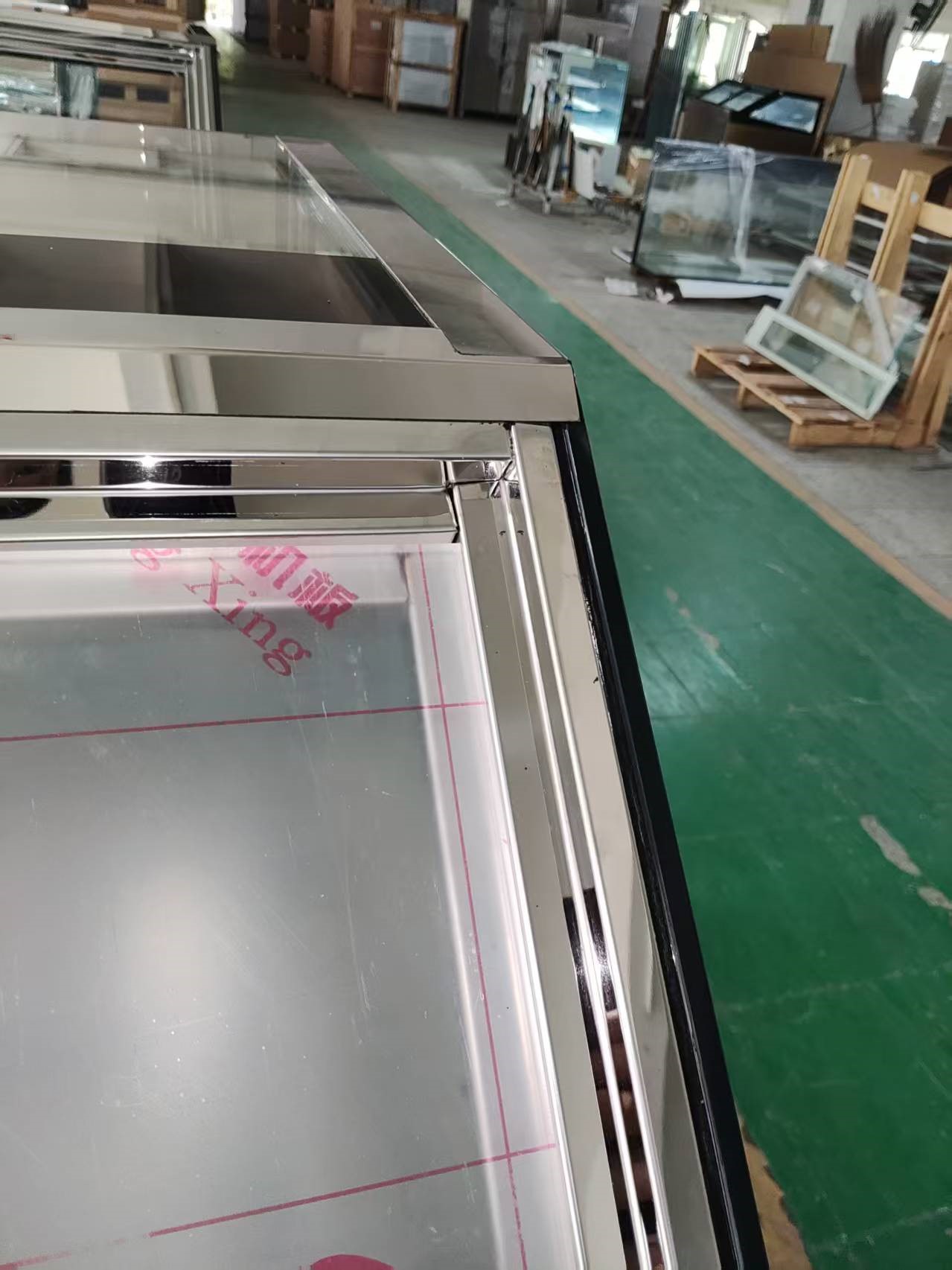
Check Process Details: High-quality stainless steel inner tanks are integrally stretch-formed, with no welding gaps, surface wire drawing/mirror polishing, no burrs or unevenness; inferior models are welded and spliced, with obvious gaps that are easy to hide dirt.
Distinguish Material Texture: 304 stainless steel has a heavy feel (the whole machine weighs 50-80kg), with a delicate surface and no or weak magnetism; ordinary steel is light (30-40kg), with a rough surface and strong magnetism; food-grade plastics are light, with a strong plastic texture and easy to scratch.
Reject Low-Price Traps: The market price of a new commercial stainless steel ice cream machine is 8000-20000 RMB. New models priced below 5000 RMB are most likely using ordinary steel or 201 stainless steel, posing serious safety hazards.
The core principle for choosing ice cream machine body materials is: food contact components must choose 304/316L stainless steel, non-contact components prioritize stainless steel, followed by food-grade plastics, and ordinary steel must be firmly rejected.
For users with different needs, the purchase suggestions are as follows:
Chain Stores/Regular Dessert Shops: Prioritize 304 all-stainless steel body. If budget allows, choose 316L stainless steel models to ensure food safety and long-term stable operation.
Small Milk Tea Shops/Convenience Stores: Choose mid-range models with 304 stainless steel inner tank + stainless steel outer shell, balancing safety, durability, and budget.
Short-Term Street Vending/Temporary Events: You can choose entry-level models with food-grade plastic auxiliary parts + 304 stainless steel inner tank, avoid ordinary steel models to eliminate safety risks.
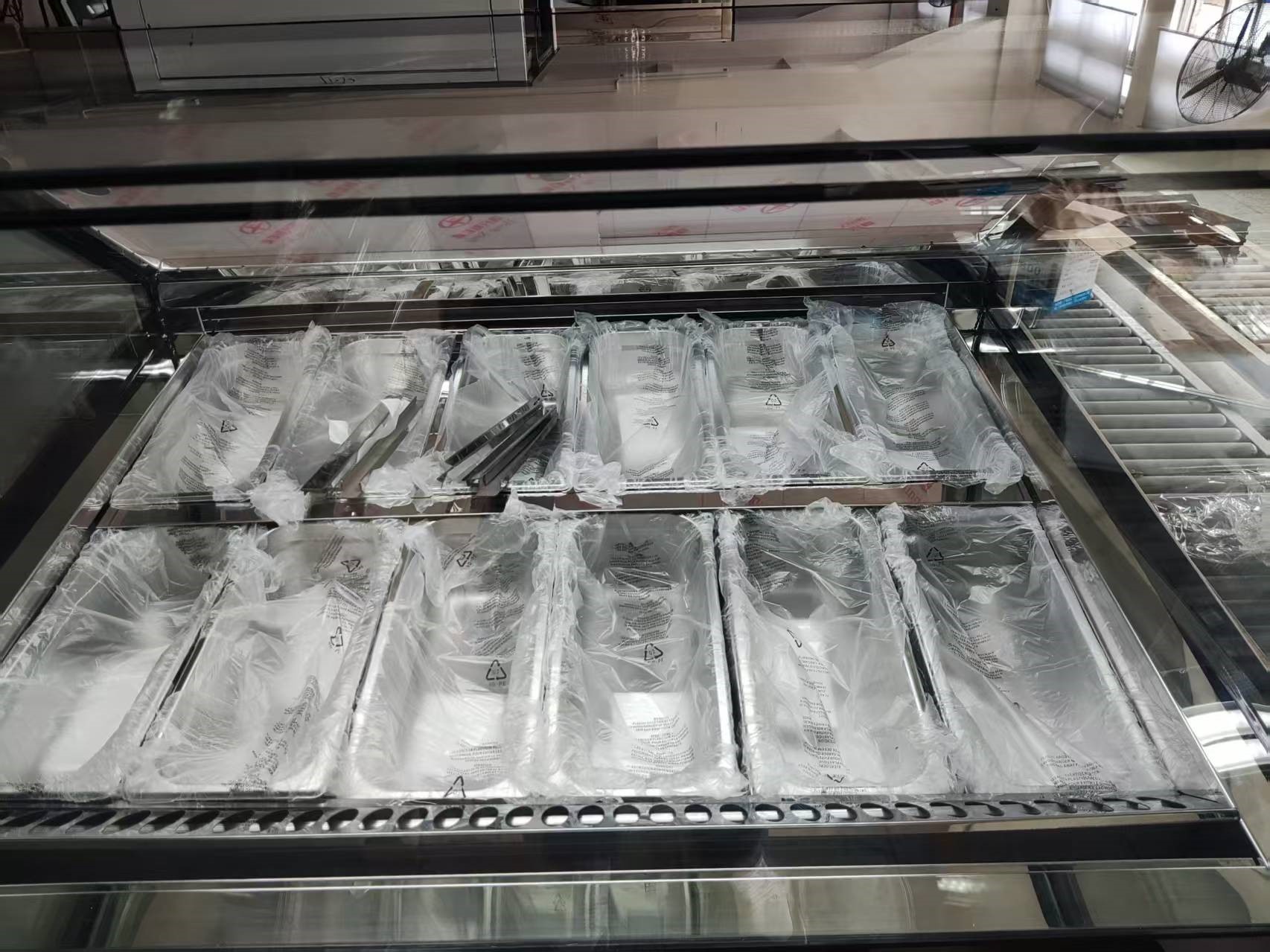
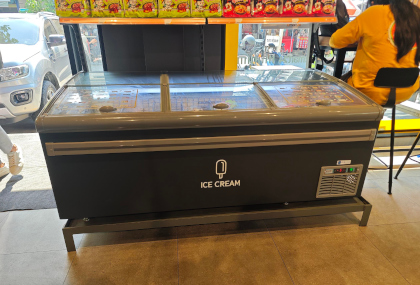
The ice cream freezers developed by Cooluma are mainly made of stainless steel, which can be pasted with background panels or adopt a bright surface body, presenting an overall transparent and sleek texture.
Most popular More «
-
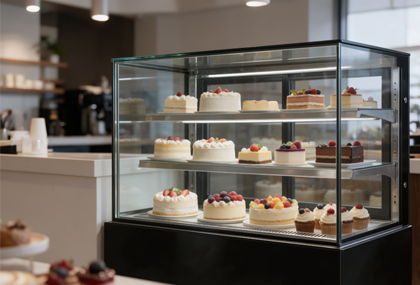
Air vs Direct Cool Cake Cabinets Advantage and Disadvantage
-
How to Choose an Open Display Cooler for Your Fruit Store?
-
What Is the Standard Temperature for Dessert Display Cabinets?
-
Top Compact Upright Display Cooler for Retail Businesses
-
SM15A Commercial Slush Machine Specification
-
Commercial Pastry Display Case Buying Guide for Bakeries & Cafés
-
Cooluma Ice Machines for Seafood Sections in Supermarkets
-
Cooluma Turnkey Coffee Shop Solution
-
How To Choose Commercial Display Freezer For Ice Cream Shop
-
Solutions to Glass Fogging & Water Dripping for Café Cake Display Fridges