









What are the differences between the industry standards for Italian ice cream and those in China?
As a globally popular frozen dessert, ice cream exhibits significant variations in industry standards due to regional culinary cultures and differing industrial models. Italy's standard system centers on artisanal gelato, reflecting a commitment to traditional craftsmanship; China, meanwhile, has established a tiered standard system tailored for industrial production and mass consumption.

I. Regulatory Framework: Multi-Layered Voluntary vs. Unified Mandatory
The underlying logic of the two countries' standard systems differs fundamentally. Italy pursues a multi-tiered path of “minimum baseline requirements + voluntary upgrades,” while China centers on “mandatory tiered classification + unified oversight.”
Italian gelato standards comprise three tiers: EU regulations, Italian National Standards (UNI), and industry association specifications. At the EU level, mandatory baseline requirements are established by Reg. (EC) No 178/2002 (General Food Law) and the Reg. (EC) No 852/853/854/882/04 Food Hygiene Package, defining boundaries for food safety and additive usage. At the national level, standards like UNI EN 16754:2016 (equipment performance) and UNI 11290:2011 (product classification) refine technical requirements. Industry association regulations are key to quality enhancement—for instance, the Italian Gelato Association (ANIG)'s “Self-Regulatory Code for Gelato Production” sets voluntary standards for artisanal gelato, with compliant businesses earning market premium recognition. Notably, Italy introduced a dedicated bill in 2021 proposing to incorporate requirements such as ≤30% air content in artisanal gelato and the prohibition of synthetic additives into mandatory regulations, further strengthening the protection of traditional craftsmanship.
China's ice cream standards center on national regulations, forming a dual structure of “mandatory safety + recommended grading”: The mandatory standard GB 2759-2015 “National Food Safety Standard: Frozen Beverages and Preparations” establishes safety thresholds for ingredients, sensory qualities, and microbiology, specifying that frozen beverages must be stored at ≤-18°C and sold at ≤-15°C. The recommended standard GB/T 31114-2024 (effective July 1, 2026) classifies ice cream into three categories: full-milk fat, semi-milk fat, and plant-based fat. By quantifying fat content through graded classifications, it enhances product positioning transparency. Additionally, GB 28050—2025 “National Food Safety Standard: General Rules for Nutrition Labeling of Prepackaged Foods” mandates labeling of seven core nutrients including energy, protein, and fat. It also requires the warning “Children and adolescents should avoid excessive intake of salt, oil, and sugar” to strengthen consumer guidance.
II. Core Ingredients: Natural Minimalism vs. Quantitative Grading
Ingredient requirements represent the core divergence between the two countries' standards, directly determining product taste, cost, and positioning. Key differences center on three dimensions: milk fat content, air content, and additive usage.
1. Milk Fat Content: Minimum Threshold vs. Graded Classification
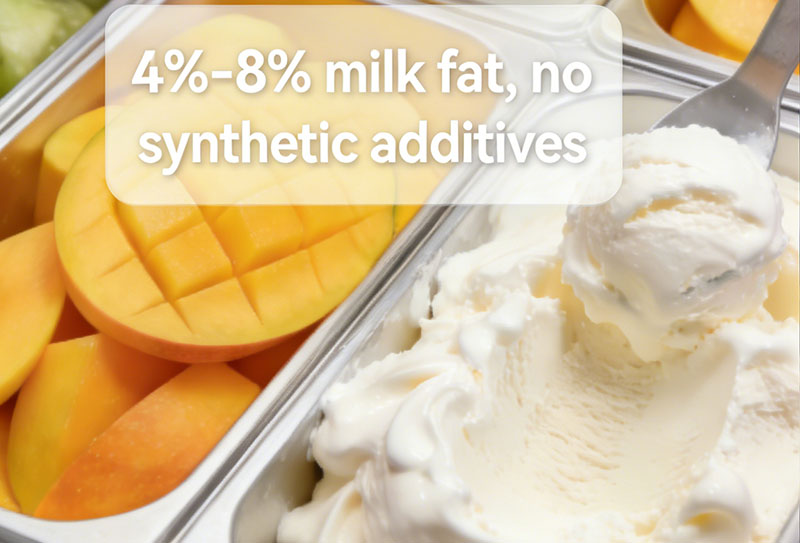
Italian law mandates gelato must contain ≥3.5% milk fat, with premium artisanal varieties recommended at 4%-8%. This approach prioritizes fresh milk bases over heavy cream, achieving a refreshing, non-cloying texture that highlights ingredient purity. Chinese standards instead use milk fat content for quality grading: Full-fat ice cream (≥8%) emphasizes dairy richness; Semi-cream ice cream ranges from 2.2% to 8%, balancing cost and texture; plant-based ice cream contains <2.2%, catering to special dietary needs and the mass market. This tiering aligns with Chinese consumers' preference for rich dairy flavor while clarifying the distinction between premium and affordable products.
2. Air Content: Strict Restrictions vs. Moderate Flexibility
Air content (expansion rate) directly impacts ice cream texture. Italian standards enforce strict controls: artisanal gelato mandates ≤30% air content, with traditional methods often limiting it to 25%-35%. Low-speed churning minimizes air incorporation, ensuring a dense, velvety texture where every bite delivers pure ingredient flavor. Chinese standards lack a mandatory upper limit for air content. Mass-produced industrial ice cream typically has expansion rates of 50%-100%. While this light, fluffy texture aligns with mainstream consumer preferences, it also leads to issues like “mild flavor and rapid melting” in some low-cost products.
3. Additive Usage: Zero Tolerance vs. Compliant Adaptation
Italy adheres to a “natural zero-tolerance” principle for additives in premium gelato: handmade gelato prohibits synthetic dyes, artificial flavors, preservatives, hydrogenated fats, and genetically modified ingredients. Water is generally not added during production, relying solely on the natural moisture from fruits and dairy products for texture. This results in a typical shelf life of no more than 10 days, necessitating same-day production and sale to ensure freshness. China's standards, however, follow a “compliant-use-permitted” approach. Additives like emulsifiers and stabilizers compliant with GB 2760 standards are allowed as long as dosage limits are not exceeded. In industrial production, additives extend shelf life (pre-packaged products can last 6-12 months), balancing production efficiency with product stability.
III. Production Process: Artisanal Craftsmanship vs. Industrial Efficiency
The divergence in production standards stems from differing industrial models: Italy prioritizes artisanal heritage, while China adapts to large-scale mass production.
Italian artisanal gelato adheres to stringent standards: ingredients undergo pasteurization at 65°C–90°C, followed by 4–24 hours of aging at 2°C–4°C to ensure full hydration; Mixing must occur slowly in open-bowl freezers to prevent excessive air incorporation; finished products require rapid freezing below -25°C to prevent large ice crystal formation that compromises texture; production-to-sale cycles are strictly limited to 10 days, with some established shops adhering to “made and sold out the same day.” This small-batch, process-intensive approach inherently results in low output and high costs for artisanal gelato.
China's production standards are entirely geared toward industrial mass production: Pasteurization or UHT (Ultra-High Temperature) flash pasteurization is used for sterilization, balancing safety and efficiency; Aging time has no mandatory requirements, typically shortened to 2-8 hours in industrial production; Mixing employs closed continuous freezers to enable large-scale continuous production; Storage and transportation only require temperatures ≤-18°C, with no explicit restrictions on production cycles. This model enables low-cost, high-volume ice cream distribution aligned with mass market demands, though it struggles to replicate the velvety texture of artisanal gelato.
IV. Labels and Certifications: Quality Endorsement vs. Information Transparency
The labeling and certification systems in both countries focus respectively on quality assurance and consumer information rights.
Italy's certification system primarily involves joint industry association and government endorsements, emphasizing quality tiers: The “Gelateria Italiana” certification, jointly launched by Italy's Ministry of Foreign Affairs and Ministry of Agriculture, specifically certifies Italian ice cream shops overseas, highlighting traditional craftsmanship and ingredient authenticity; IGI certification (Italian Gelato Institute) covers the entire industrial ice cream production process, ensuring consistent product quality; while Carpigiani Gelato University's skill certification serves as the authoritative endorsement for artisanal craftsmanship. Labeling emphasizes production attributes, with phrases like “handmade fresh” and “no additives” becoming key signals for consumers to identify high-quality gelato.
China's labeling and certification systems adhere to national standards, with transparency as their core principle: Prepackaged ice cream must comply with GB 7718-2011 labeling requirements, listing ingredients in descending order by weight and clearly indicating product category (full-fat cream/semi-fat cream/vegetable fat). Nutrition labels must follow GB 28050-2025 requirements, clearly displaying energy and key nutrient contents in a “boxed table” format. Certification focuses on food safety, such as SC production permits and HACCP system certifications, emphasizing safety controls throughout the production process.
V. Special Categories: Precise Definitions vs. Unified Standards
For special categories like sorbet and low-fat products, the two countries' standards exhibit differing regulatory approaches. Italy employs more precise definitions: Sorbetto requires zero fat and zero dairy, made solely from water, sugar, and fruit with ≥25% juice content; low-fat Gelato has ≤4% milk fat; vegan Gelato explicitly prohibits animal ingredients and mandates plant-based milk alternatives. China, however, incorporates special categories into a unified frozen beverage classification system. For instance, GB/T 30590-2014 “Classification of Frozen Beverages” clearly distinguishes categories like ice cream, popsicles, and slushies. sorbet products follow the separate GB/T 31118 standard, primarily composed of water, sugar, and fruit juice, with no mandatory fat content requirements. This standard emphasizes product form differentiation over ingredient purity.
Demand Alignment Behind the Differences
The divergence in Chinese and Italian ice cream standards fundamentally reflects alignment with distinct industrial models and consumer demands: Italian standards prioritize artisanal craftsmanship, safeguarding Gelato's traditional quality through stringent ingredient and process requirements to meet consumer expectations for natural flavors and ritualistic experiences; Chinese standards orient toward industrial production, achieving quality transparency and cost balance through tiered management to satisfy mass market accessibility needs.
For industry practitioners, precise alignment with target market standards is essential: entering the Italian market requires adherence to natural ingredients and artisanal craftsmanship, while expanding into China demands clear product tier positioning that complies with labeling and safety regulations. For consumers, understanding these differences empowers better choices—those favoring rich, natural textures should select artisanal gelato meeting Italian association standards, while value-conscious consumers may opt for products compliant with China's full-fat or half-fat cream standards.





Most popular More «
-

Air vs Direct Cool Cake Cabinets Advantage and Disadvantage
-
How to Choose an Open Display Cooler for Your Fruit Store?
-
What Is the Standard Temperature for Dessert Display Cabinets?
-
Top Compact Upright Display Cooler for Retail Businesses
-
SM15A Commercial Slush Machine Specification
-
Commercial Pastry Display Case Buying Guide for Bakeries & Cafés
-
Cooluma Ice Machines for Seafood Sections in Supermarkets
-
Cooluma Turnkey Coffee Shop Solution
-
How To Choose Commercial Display Freezer For Ice Cream Shop
-
Solutions to Glass Fogging & Water Dripping for Café Cake Display Fridges