









How to Control the Procurement Cost of Open Refrigerated Display Cabinets for Supermarkets
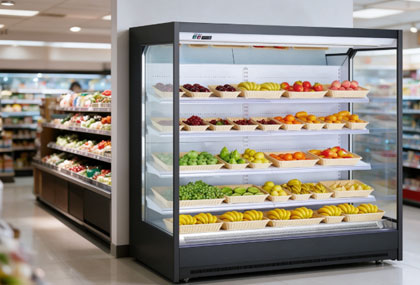
Open refrigerated display cabinets are core equipment for displaying fresh food, beverages and cooked food in supermarkets. Procurement is far more than simply comparing prices for selection. Solely pursuing low prices tends to trigger a sharp rise in hidden costs such as high energy consumption, frequent breakdowns and expensive maintenance in later periods. To cut costs and improve efficiency, supermarkets need to abandon the traditional mindset of "only focusing on the unit procurement price". Based on the full life-cycle cost, precise control should be carried out from multiple dimensions including model selection, procurement, channels, operation & maintenance and bulk planning, so as to achieve the optimal balance between upfront investment and later operation.
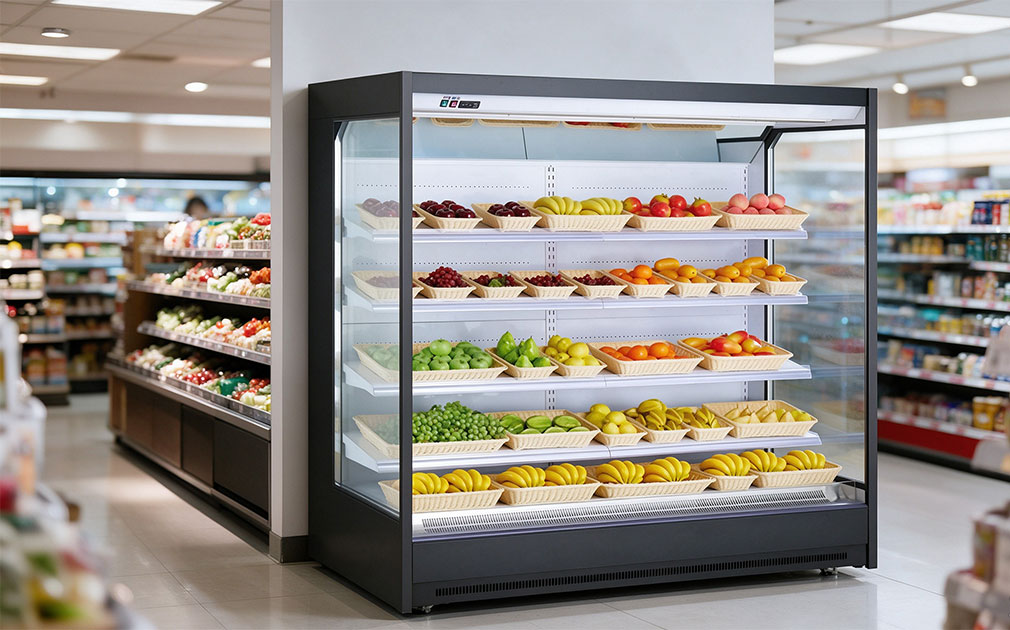
Establishing the concept of full life-cycle cost is the core prerequisite for controlling the procurement cost of display cabinets. Most supermarkets make the procurement mistake of excessively suppressing equipment unit prices while ignoring long-term operating costs. In fact, the total cost of an open refrigerated display cabinet covers four major parts: procurement cost, energy consumption cost, maintenance cost and depreciation loss. Among them, long-term energy consumption and operation & maintenance costs account for a much larger proportion than the initial purchase price. Relevant industry data shows that for commercial refrigerated display cabinets, energy consumption costs can account for up to 90% throughout their full life cycle. Low-price and low-energy-efficiency equipment seems to save money, but it will lead to a substantial overrun in annual electricity bills. It is also prone to problems such as compressor failure and uneven refrigeration, resulting in additional losses including commodity spoilage and business suspension for maintenance. Therefore, the core procurement logic should shift from "low-price purchasing" to "cost-effective long-term operation". Enterprises should first calculate the total 5-year full life-cycle cost instead of merely comparing one-off quotations, so as to avoid waste of hidden costs from the source.
Accurately matching demands and conducting scientific model selection is a key step to strictly control procurement costs. Stores of different sizes and with different business categories have significantly different requirements for specifications and functions of display cabinets. Blindly choosing oversize and fully functional high-end models will cause redundant equipment and idle capital. On the contrary, low-end models cannot meet the display and fresh-keeping requirements and will bring operational losses.
Model selection should be carried out according to the actual store scenarios during procurement. Small community supermarkets may adopt compact air-cooled display cabinets to balance display effect and space utilization. Large comprehensive supermarkets can select standard models with corresponding temperature zones for fresh food and beverage zones separately.
Meanwhile, attention should be paid to the energy efficiency configuration of equipment. Priority should be given to models with Level 1 energy efficiency, equipped with variable-frequency compressors, LED energy-saving lighting and night energy-saving curtains. Although such equipment has a slightly higher unit procurement price, it can reduce energy consumption by 30%–40% and bring considerable long-term energy-saving benefits. In addition, choose materials and accessories reasonably. Prefer models with common accessories such as conventional environmentally friendly refrigerants and thickened explosion-proof tempered glass. Avoid models with niche customized accessories which may bring premium charges for later repairs, so as to effectively cut maintenance costs.
Optimizing procurement channels and modes can directly reduce rigid upfront procurement expenditure. The multi-level distribution model of traditional dealers generates price differences for middlemen and premium charges for warehousing and logistics, pushing up equipment procurement costs. In response, supermarkets can adjust procurement channels and directly cooperate with original manufacturers to eliminate intermediate circulation links. The procurement cost of equipment of the same specification can be reduced by more than 25%.
For chain supermarkets and procurement scenarios of multi-store expansion, the bulk centralized procurement mode can be adopted. Most manufacturers in the industry provide tiered discounts and rebate policies for bulk orders of more than 10 units, greatly lowering the unit procurement cost.
Note that a standardized quotation review mechanism shall be formulated during procurement. Suppliers should be required to provide detailed quotation sheets specifying various fees for the main equipment, installation, transportation, quality guarantee and after-sales service to put an end to hidden charges. At the same time, compare quotations from 3–5 qualified manufacturers, and conduct comprehensive screening combining qualifications, reputation and after-sales capacity to prevent low-price but inferior equipment from being purchased.
Signing long-term after-sales agreements and advancing operation & maintenance planning help reduce later hidden costs. Equipment after-sales and maintenance costs are extensions of procurement costs and also cost loopholes that are easy to overlook. At the contract signing stage, after-sales terms should be clearly stipulated. Priority should be given to suppliers offering a quality guarantee of 3 years or longer for core components and low-cost lifelong maintenance, so as to effectively avoid high expenditure on replacing spare parts due to equipment failures in the short term.
Reject the operation mode of "valuing procurement over maintenance". During procurement, contact manufacturers to obtain standardized operation & maintenance schemes, and clarify the cycles and standards for daily cleaning, defrosting, filter replacement and unit inspection to lower equipment failure rates. A sound operation & maintenance system can effectively extend equipment service life, reduce losses caused by shutdown maintenance, maximize the amortization of equipment depreciation costs, and realize worry-free long-term cost reduction after one-time procurement.
In addition, standardized procurement and inventory coordination can further optimize the cost structure. Chain supermarkets can formulate unified equipment procurement standards, fix model parameters, energy efficiency standards and after-sales requirements to realize bulk standardized procurement, enhance bargaining power, and facilitate universal spare parts and unified maintenance in later periods, lowering operation & maintenance complexity and costs. For single-store procurement, the purchase quantity can be reasonably planned and precisely matched with store display demands to avoid idle equipment waste. Meanwhile, priority can be given to reusable and relocatable standard models to adapt to scenarios such as store layout adjustment and new store relocation, improving equipment utilization and activating the value of fixed assets.
Most popular More «
-
How to Control the Procurement Cost of Open Refrigerated Display Cabinets for Supermarkets
-
Air vs Direct Cool Cake Cabinets Advantage and Disadvantage
-
How to Choose an Open Display Cooler for Your Fruit Store?
-
What Is the Standard Temperature for Dessert Display Cabinets?
-
Top Compact Upright Display Cooler for Retail Businesses
-
SM15A Commercial Slush Machine Specification
-
Commercial Pastry Display Case Buying Guide for Bakeries & Cafés
-
Cooluma Ice Machines for Seafood Sections in Supermarkets
-
Cooluma Turnkey Coffee Shop Solution
-
How To Choose Commercial Display Freezer For Ice Cream Shop