









2026 EU-U.S. Commercial Refrigeration Efficiency Standards Analysis & Impacts
As the global carbon neutrality process accelerates, commercial refrigeration equipment, as a core energy-consuming device in the food service, bakery, retail and other sectors, has seen its energy efficiency upgrade become the central focus of market access and industry competition in the European and U.S. markets. In 2026, the European Union (EU) and the United States (U.S.) will simultaneously implement new energy efficiency standards for commercial refrigeration equipment, covering all product categories including cake display cases, bread display cases, and commercial refrigerators. These standards will not only significantly raise the bar for energy efficiency, but also establish systematic constraints in terms of testing methods, certification systems, environmental indicators and other aspects. For Chinese commercial refrigeration enterprises that have laid out their presence in the EU and U.S. markets, accurately grasping the core requirements, compliance essentials and technological trends of the 2026 EU and U.S. energy efficiency standards is not only a prerequisite for breaking through trade barriers, but also the key to achieving product upgrading and seizing share in the high-end market.
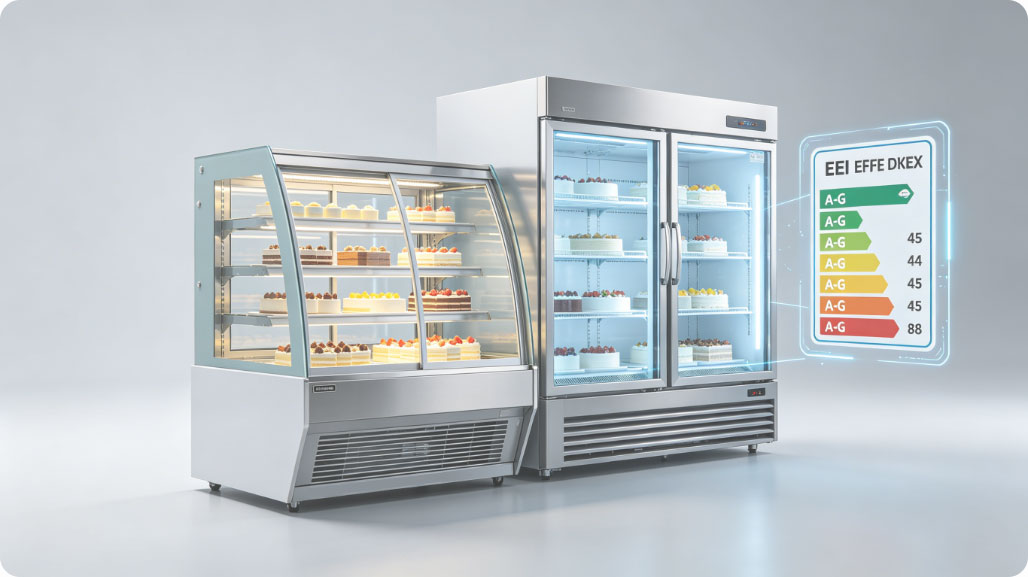
I. Core Requirements of the EU's 2026 Energy Efficiency Standards for Commercial Refrigeration Equipment
The EU's energy efficiency management for commercial refrigeration equipment is centered on the Ecodesign Directive (ErP/Ecodesign) and the Energy Labeling Regulation. The standards in effect for 2026 are (EU) 2019/2024 (Ecodesign) and (EU) 2019/2018 (Energy Labeling), supported by the EN ISO 23953-2:2023 testing standard. These rules have been mandatory since June 30, 2024, and will be fully implemented in 2026.
The standards cover self-contained commercial refrigerators, freezers, cake display cases, bakery refrigerators and other equipment applicable to scenarios such as bakeries, coffee shops, and supermarkets. The core indicators focus on four dimensions: Energy Efficiency Index (EEI), energy efficiency class, test conditions, and environmental compliance.
(1) EEI Limit Requirements
The EU uses the Energy Efficiency Index (EEI) as its core assessment indicator. A lower EEI indicates higher energy efficiency, with a baseline value of 100 (corresponding to the average energy efficiency level in 2015). The EEI limits for refrigeration equipment in 2026 continue the phased tightening logic, with differentiated settings for different types of equipment:
- Standard commercial refrigerators (including cake display cases and bread display cases): The EEI limit of <85, which took effect in July 2019, will remain in place in 2026. In addition, a new calculation requirement for Total Display Area (S_TDA) has been added to accurately match the energy consumption characteristics of bakery display equipment;
- Heavy-duty commercial refrigerators (for large-capacity supermarket use): EEI < 115, mainly targeting large-capacity display cabinets in the bakery sections of large supermarkets;
- Display cabinets with direct sales function (curved glass cake display cases, open-front bread display cases): Additional requirements will be added in 2026, including standby power consumption ≤1.5W and a 10% reduction in energy consumption during defrost mode.
(2) Energy Efficiency Classification and Labeling Requirements
Since March 2021, commercial energy efficiency labels have adopted a 7-tier classification system from A (most efficient) to G (least efficient), replacing the previous A+++ to D system. In 2026, the label information will be further refined:
- Class A: EEI < 30, corresponding to high-end energy-saving cake display cases and smart temperature-controlled bread display cases, which are the mainstream demand in the high-end bakery market;
- Class B: 30 ≤ EEI < 45, mid-range commercial display cabinets, suitable for small and medium-sized bakeries and coffee shops;
- Class C: 45 ≤ EEI < 60, entry-level equipment, whose market share in the EU will gradually shrink starting from 2026;
- Class D-G: EEI ≥ 60, which will be banned from sale in the EU market starting from 2026, completely phasing out high-energy-consumption equipment.
Labels are mandatory to mark four core pieces of information: annual energy consumption (kWh/year), display area, temperature control range, and refrigerant Global Warming Potential (GWP) value. In addition, products must be registered in the EU's EPREL database; equipment without compliant labels cannot clear customs for sale.
(3) Testing Standards and Compliance Certification
In 2026, the EU will enforce the EN ISO 23953-2:2023 testing standard, whose core updates compared to the old version include:
- New energy consumption testing methods for liquid-cooled condensing units and indirect refrigeration systems, covering new energy-efficient cake display cases;
- Clear energy consumption accounting rules for electronic expansion valves and inverter compressors, to encourage technological upgrading;
- New adaptation requirements for low GWP (≤750) refrigerants in refrigerant testing, which are also aligned with the EU F-Gas Regulation. In terms of compliance certification, products must pass CE certification (covering LVD, EMC and RoHS) and ErP energy efficiency certification. Starting from 2026, products entering the UK market will additionally need to provide UKCA certification, otherwise they cannot access the UK market.
II. Core Requirements of the U.S. 2026 Energy Efficiency Standards for Commercial Refrigeration Equipment
Energy efficiency regulation for refrigeration equipment is led by the U.S. Department of Energy (DOE), formulated under the Energy Policy and Conservation Act (EPCA). In December 2024, the DOE released a new final rule, which will be officially enforced on January 22, 2029. However, starting from 2026, equipment imported into the U.S. will need to meet pre-compliance testing requirements in advance, and the ENERGY STAR certification standards will be tightened simultaneously. The standards cover commercial refrigerators, freezers, cake display cases, and bakery-specific refrigerators, with Maximum Daily Energy Consumption (MDEC) as the core assessment indicator, with differentiated limits set based on equipment volume and display area.
(1) Core Energy Efficiency Indicator (MDEC)
The U.S. market uses the Maximum Daily Energy Consumption (MDEC, in kWh/day) as its core indicator. The 2026 pre-compliance requirements for bakery display equipment are as follows:
- Vertical closed cake display cases (volume <15 cubic feet): MDEC ≤ 0.026V + 0.8 (V is volume in cubic feet);
- Horizontal bread display cases (volume 15-30 cubic feet): MDEC ≤ 0.05V + 0.45;
- Open-front bakery display cases (with night curtains): The MDEC limit is 30% higher than that for closed models, but starting from 2026, the night curtain energy efficiency is required to be ≥80%.
(2) Upgrade of ENERGY STAR Certification
As a high-end energy efficiency label in the U.S. market, the ENERGY STAR certification standards in 2026 will be 20% stricter compared to the 2017 version:
- Certification threshold: The product's MDEC must be 30% lower than the DOE baseline standard, with EEI ≤50 (equivalent to EU Class B or above);
- Additional requirements: Inverter compressor penetration rate ≥90%, standby power consumption ≤1.0W, and 15% reduction in energy consumption for anti-fog glass;
- Market value: Certified products can access U.S. chain bakeries and high-end supermarkets, with a procurement premium of 15%-20%.
(3) Testing and Certification Compliance
The U.S. adopts the 10 CFR Part 431 testing standard. In 2026, a new high ambient temperature (32℃) condition test will be added to adapt to the high summer temperatures in Europe and the U.S. For certification, products must pass DOE certification and ENERGY STAR certification (optional but recommended), while also providing NSF food-grade certification (to ensure compliance of food contact components), otherwise they cannot enter the U.S. food service and bakery market.
III. Core Commonalities and Differences Between the 2026 EU and U.S. Energy Efficiency Standards
(1) Common Trends
- Significant increase in energy efficiency thresholds: The 2026 EU and U.S. standards are on average 25%-30% stricter than the 2020 versions, phasing out high-energy-consumption equipment and forcing industry-wide technological upgrading;
- Synergy between environmental protection and energy efficiency: Both regions restrict high GWP refrigerants (such as R404A) and prioritize adaptation to low GWP working fluids such as R600a and R134a, in line with carbon neutrality goals;
- Full lifecycle management: The scope has expanded from single energy consumption testing to the entire process of design, production, usage and recycling, requiring repairability of spare parts and recyclability of materials;
- Stricter and interoperable certification: Information from the EU EPREL database and the U.S. DOE database is gradually becoming interoperable. Starting from 2026, the scope of "one test, mutual recognition" will be expanded, reducing compliance costs for enterprises.
(2) Key Differences
| Comparison Dimension | EU Standards | U.S. Standards |
| Core Indicator | Energy Efficiency Index (EEI) | Maximum Daily Energy Consumption (MDEC) |
| Classification System | 7-tier A-G classification, mandatory labeling | No mandatory classification; ENERGY STAR serves as a high-end label |
| Test Conditions | Ambient temperature 25℃, humidity 50% | Ambient temperature 23℃±1℃, with an additional 32℃ high-temperature condition |
| Compliance Focus | EEI limits + EPREL registration + UKCA | DOE certification + NSF + ENERGY STAR (for high-end market) |
| Implementation Timeline | Fully enforced in 2026 | Pre-compliance in 2026, official enforcement in 2029 |
IV. Far-Reaching Impacts of the 2026 EU and U.S. Energy Efficiency Standards on the Industry
(1) Reshaping of Market Landscape and Phasing Out of Low-End Production Capacity
Following the implementation of the 2026 EU and U.S. energy efficiency standards, low-end cake display cases and bread display cases with EEI >60 (below EU Class D) or excessive MDEC will completely withdraw from the EU and U.S. markets. If small and medium-sized Chinese export enterprises fail to meet the standards, they will lose their share in the European and U.S. markets. The industry will accelerate its concentration towards leading enterprises with technological R&D capabilities and complete compliance qualifications, leading to increased market concentration.
(2) Accelerated Technological Upgrading and Iteration of Core Components
To meet the 2026 energy efficiency requirements, the technical roadmap for commercial refrigeration equipment will be fully upgraded:
- Compressors: The penetration rate of inverter compressors will increase from 60% to 90%, and CO₂ transcritical compressors and permanent magnet synchronous compressors will gradually see large-scale application;
- Insulation technology: The thickness of the polyurethane foam layer will increase by 5mm, and the penetration rate of Vacuum Insulation Panels (VIP) in high-end cake display cases will reach 40%;
- Smart control: IoT remote temperature control and AI energy-saving algorithms will become standard configurations, which can automatically adjust temperature and humidity according to the storage requirements of bakery products, reducing energy consumption by 15%-20%;
- Glass technology: Low-E anti-fog glass will be widely adopted, reducing heat transfer and defrosting energy consumption.
(3) Rising Compliance Costs and Intensified Trade Barriers
In 2026, certification and testing fees in Europe and the U.S. will increase by 20%-30% compared to 2023. For a single product model, EU ErP+CE certification costs approximately RMB 15,000-20,000, while U.S. DOE+ENERGY STAR certification costs around RMB 20,000-25,000, with the testing cycle extended to 8-10 weeks. Meanwhile, Europe and the U.S. are strengthening import inspection efforts. Non-compliant products face penalties including product returns and fines of up to $750,000 per unit. Compliance costs have become the core pressure for small and medium-sized export enterprises.
(4) Emerging Opportunities in the High-End Market and Expanded Premium Space
In 2026, demand for cake display cases and bread display cases featuring Class A energy efficiency, smart temperature control, and low GWP refrigerants will surge in the EU and U.S. high-end bakery market (covering independent bakeries, specialty coffee shops, and high-end supermarkets), with product premiums reaching 20%-30%. Leveraging their cost-performance advantages, if leading Chinese enterprises can quickly launch compliant products, they can seize share in the EU and U.S. high-end market, achieving a transformation from "price competition" to "technology + brand" competition.
V. Compliance Response Pathways for Chinese Enterprises
(1) Benchmark Standards in Advance and Optimize Product Design
Centering on the 2026 EU EEI ≤85 and U.S. MDEC limits, enterprises should optimize their refrigeration systems by adopting energy-saving components such as inverter compressors, high-efficiency fans, and vacuum insulation panels;
Adapt to low GWP refrigerants (R600a, R455A) to simultaneously meet the EU F-Gas Regulation and U.S. environmental requirements;
Upgrade smart control systems by adding IoT remote monitoring and automatic energy-saving modes to enhance product added value.
(2) Improve the Certification System and Complete Compliance Registration in Advance
Prioritize processing EU CE+ErP+EPREL registration and U.S. DOE+NSF certification, and additionally apply for ENERGY STAR certification for high-end products;
Lay out the UKCA certification for the UK market starting from 2026 to avoid market access risks in the UK;
Establish compliance files, retain test reports, certification certificates, and label registration information to prepare for EU and U.S. random inspections.
(3) Focus on Segmented Scenarios and Accurately Match Demand
Target the core bakery scenarios in Europe and the U.S. and develop differentiated products:
- For independent bakeries: Launch bread display cases featuring Class A energy efficiency, compact size, and built-in design;
- For specialty coffee shops: Launch cake display cases with curved glass, warm LED lighting, and smart temperature control;
- For high-end supermarkets: Develop large-capacity, frost-free air-cooled, low-energy-consumption bakery refrigerators.
(4) Strengthen Supply Chain Management to Reduce Compliance Risks
Select core component suppliers (compressors, temperature controllers, glass) with EU and U.S. certifications to ensure component compliance;
Establish a full lifecycle traceability system to record information across the entire process of product design, production, testing, and sales, to meet EU and U.S. information disclosure requirements;
Track dynamic updates to EU and U.S. standards, and anticipate the further tightening trend of the U.S. official mandatory standards in 2029 in advance.
The implementation of the 2026 EU and U.S. energy efficiency standards for commercial refrigeration equipment marks a critical node in the green transition of the global refrigeration industry. It not only raises the market access threshold, but also spawns opportunities in the high-end market. For Chinese commercial refrigeration enterprises, challenges and opportunities coexist: in the short term, they need to bear the pressure of rising compliance costs and technological upgrading investment; in the long run, energy efficiency upgrading will drive the industry to phase out low-end production capacity, force enterprises to pursue technological innovation, and help Chinese brands seize share in the EU and U.S. high-end bakery equipment market.
Looking ahead, as the carbon neutrality goal continues to advance, EU and U.S. energy efficiency standards will be further tightened. High energy efficiency, low GWP, intelligence, and recyclability will become the core development directions for commercial refrigeration equipment. Only by keeping up with standard dynamics, increasing R&D investment, improving compliance systems, and focusing on the needs of segmented scenarios can Chinese enterprises take the initiative in global market competition and achieve the leap from a "manufacturing giant" to a "manufacturing power".
Most popular More «
-
Air vs Direct Cool Cake Cabinets Advantage and Disadvantage
-
How to Choose an Open Display Cooler for Your Fruit Store?
-
What Is the Standard Temperature for Dessert Display Cabinets?
-
Top Compact Upright Display Cooler for Retail Businesses
-
SM15A Commercial Slush Machine Specification
-
Commercial Pastry Display Case Buying Guide for Bakeries & Cafés
-
Cooluma Ice Machines for Seafood Sections in Supermarkets
-
Cooluma Turnkey Coffee Shop Solution
-
How To Choose Commercial Display Freezer For Ice Cream Shop
-
Solutions to Glass Fogging & Water Dripping for Café Cake Display Fridges